Experimental psychology · Homepage figure
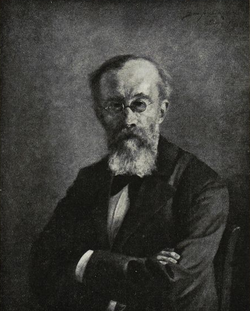
Wilhelm Wundt
1832–1920
A short biography
The German physiologist, philosopher and researcher Wundt worked in Leipzig. His experimental psychology laboratory/institute, established in 1879, was an important milestone in psychology becoming a distinct university research field.
His training in physiology and interests in philosophy came together in Leipzig, where students could learn experimental research. Laboratories, instruments and training practices helped establish a transferable academic tradition.
What does this figure represent in psychology?
He represents the systematic observation and experimental study of mental processes. On the homepage he marks a shift from philosophical questions towards research methods.
Controlled study of sensation, attention and reaction time differed from casual introspection. He also studied language and culture without reducing every question to laboratory experiments. Experimental psychology is therefore a methodological development, not a claim that one method answers everything.
Key concepts
Controlled observation: systematically arranging conditions. Apperception: a historical account of selecting and organising mental contents.
A question for the reader
What does reaction time reveal, and which aspects of a person’s experience does it leave outside the measurement?
Selected works and publications
Links lead to original texts, institutional catalogues or publication records; not every link provides a free full text. Work titles are retained in their original or established language.
Reading in context
Psychology did not begin with one person alone; laboratory history is part of a wider scientific context.
Sources
Source check: 16 October 2026. Institutional biographies and accessible bibliographic records were consulted; some records were checked through indexed summaries. Complete works were not all read. Concept connections and questions were written for this collection.