Philosophical roots · Homepage figure
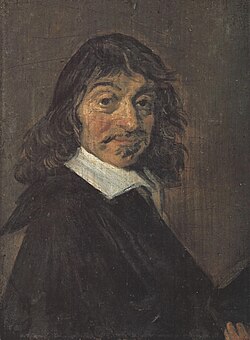
René Descartes
1596–1650
A short biography
The French philosopher and mathematician Descartes investigated knowledge, thinking and the workings of the body. He made the relationship between mind and body a central philosophical question.
He used doubt as a method while seeking a reliable starting point for knowledge. Mathematics and natural philosophy placed his questions about thinking alongside attempts to explain bodily mechanisms.
What does this figure represent in psychology?
His discussions of the certainty of thought and the bodily aspects of emotion belong to psychology’s philosophical background. On the homepage he represents questioning thought.
Distinguishing mind from body left later thinkers a lasting problem about subjective experience and physical processes. His writing on emotion also considers bodily involvement. Students can use these texts to identify the assumptions behind an explanation.
Key concepts
Methodical doubt: examining grounds for a claim. Mind–body problem: explaining relationships between thought and physical processes.
A question for the reader
Distinguish bodily signs of an emotion from its meaning. Does describing them separately prove that they are independent?
Selected works and publications
- Meditationes de prima philosophia · Meditations1641
- Les Passions de l’âme · The Passions of the Soul1649
Links lead to original texts, institutional catalogues or publication records; not every link provides a free full text. Work titles are retained in their original or established language.
Reading in context
Descartes’s philosophy is not CBT; historical connections do not establish a clinical method.
Sources
- Stanford Encyclopedia of Philosophy · René Descartes
- Stanford Encyclopedia of Philosophy · Descartes on the Emotions
Source check: 16 October 2026. Institutional biographies and accessible bibliographic records were consulted; some records were checked through indexed summaries. Complete works were not all read. Concept connections and questions were written for this collection.