Philosophical roots · Homepage figure
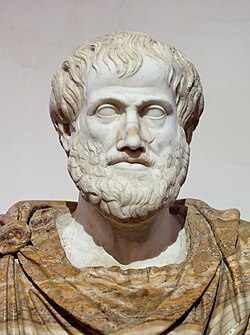
Aristoteles
384–322 BCE
A short biography
The ancient Greek philosopher Aristotle examined life, perception and thought alongside the study of nature. His work in Athens formed a broad tradition of comparing human beings with other living things.
After studying in Plato’s Academy, he developed his own teaching and research community at the Lyceum. His work on living things connects with his logic and ethics through questions about functions and explanation.
What does this figure represent in psychology?
In On the Soul, he considered perception and mental capacities. On the homepage he represents an early philosophical interest in observation and knowing.
Soul here includes capacities of living organisms, not just an individual inner life. Reading On the Soul as a modern mental-health manual would obscure that difference. Ask how an account of perception could be turned into an observable question.
Key concepts
Capacities of life: nutrition, perception and thought as different functions. Perception: distinguishing an object from the process of sensing it.
A question for the reader
Compare Aristotle and Descartes on mind and body. Which claims are philosophical explanations, and which could become measurable questions?
Selected works and publications
- De Anima · Ruh ÜzerineAntiquity
Links lead to original texts, institutional catalogues or publication records; not every link provides a free full text. Work titles are retained in their original or established language.
Reading in context
He was not a psychologist in the modern sense; his account of soul should not be equated with current psychological concepts.
Sources
Source check: 16 October 2026. Institutional biographies and accessible bibliographic records were consulted; some records were checked through indexed summaries. Complete works were not all read. Concept connections and questions were written for this collection.